Host Protocol Stack
For the naming, classification, and member composition of structures in the host protocol stack, refer to the following two diagrams:
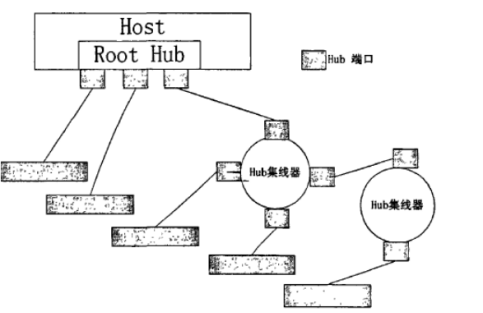
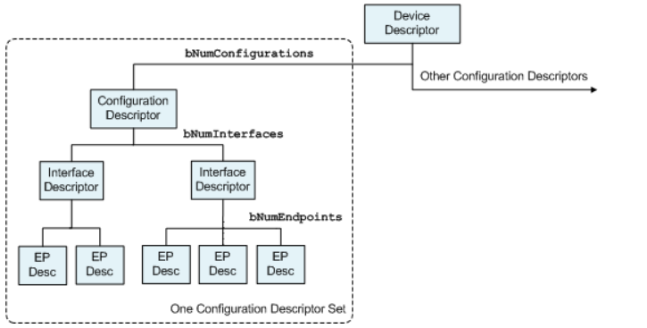
CORE
CLASS Driver Information Structure
struct usbh_class_info {
    uint8_t match_flags;           /* Used for product specific matches; range is inclusive */
    uint8_t bInterfaceClass;       /* Base device class code */
    uint8_t bInterfaceSubClass;    /* Sub-class, depends on base class. Eg. */
    uint8_t bInterfaceProtocol;    /* Protocol, depends on base class. Eg. */
    const uint16_t (*id_table)[2]; /* List of Vendor/Product ID pairs */
    const struct usbh_class_driver *class_driver;
};
Endpoint Structure
struct usbh_endpoint {
    struct usb_endpoint_descriptor ep_desc;
};
Interface Altsetting Structure
struct usbh_interface_altsetting {
    struct usb_interface_descriptor intf_desc;
    struct usbh_endpoint ep[CONFIG_USBHOST_MAX_ENDPOINTS];
};
Interface Structure
struct usbh_interface {
    char devname[CONFIG_USBHOST_DEV_NAMELEN];
    struct usbh_class_driver *class_driver;
    void *priv;
    struct usbh_interface_altsetting altsetting[CONFIG_USBHOST_MAX_INTF_ALTSETTINGS];
    uint8_t altsetting_num;
};
Configuration Structure
struct usbh_configuration {
    struct usb_configuration_descriptor config_desc;
    struct usbh_interface intf[CONFIG_USBHOST_MAX_INTERFACES];
};
hubport Structure
struct usbh_hubport {
    bool connected;   /* True: device connected; false: disconnected */
    uint8_t port;     /* Hub port index */
    uint8_t dev_addr; /* device address */
    uint8_t speed;    /* device speed */
    uint8_t depth;    /* distance from root hub */
    uint8_t route;    /* route string */
    uint8_t slot_id;  /* slot id */
    struct usb_device_descriptor device_desc;
    struct usbh_configuration config;
    const char *iManufacturer;
    const char *iProduct;
    const char *iSerialNumber;
    uint8_t *raw_config_desc;
    struct usb_setup_packet *setup;
    struct usbh_hub *parent;
    struct usbh_hub *self; /* if this hubport is a hub */
    struct usbh_bus *bus;
    struct usb_endpoint_descriptor ep0;
    struct usbh_urb ep0_urb;
    usb_osal_mutex_t mutex;
};
hub Structure
struct usbh_hub {
    bool connected;
    bool is_roothub;
    uint8_t index;
    uint8_t hub_addr;
    uint8_t speed;
    uint8_t nports;
    uint8_t powerdelay;
    uint8_t tt_think;
    bool ismtt;
    struct usb_hub_descriptor hub_desc; /* USB 2.0 only */
    struct usb_hub_ss_descriptor hub_ss_desc; /* USB 3.0 only */
    struct usbh_hubport child[CONFIG_USBHOST_MAX_EHPORTS];
    struct usbh_hubport *parent;
    struct usbh_bus *bus;
    struct usb_endpoint_descriptor *intin;
    struct usbh_urb intin_urb;
    uint8_t *int_buffer;
    struct usb_osal_timer *int_timer;
};
usbh_initialize
usbh_initialize is used to initialize the USB host protocol stack, including: initializing the USB host controller, creating roothub device, creating hub detection thread.
int usbh_initialize(uint8_t busid, uint32_t reg_base, usbh_event_handler_t event_handler);
busid bus id, starting from 0, cannot exceed CONFIG_USBHOST_MAX_BUS
reg_base hcd register base address
event_handler host event callback function, can be NULL
return 0 indicates normal, other values indicate error
usbh_find_class_instance
usbh_find_class_instance finds the corresponding class structure handle based on the registered class name.
void *usbh_find_class_instance(const char *devname);
devname class name
return class structure handle
lsusb
lsusb is used to view and operate device information on the hub. Requires shell plugin to use.
int lsusb(int argc, char **argv);
SERIAL
usbh_serial_open
usbh_serial_open opens a serial device according to the path.
struct usbh_serial *usbh_serial_open(const char *devname, uint32_t open_flags);
devname serial path
open_flags open flags, refer to USBH_SERIAL_OFLAG_* definitions
return serial structure handle
usbh_serial_close
usbh_serial_close closes the serial device.
void usbh_serial_close(struct usbh_serial *serial);
serial serial structure handle
usbh_serial_control
usbh_serial_control configures the serial port.
int usbh_serial_control(struct usbh_serial *serial, int cmd, void *arg);
serial serial structure handle
cmd control command, refer to USBH_SERIAL_CMD_* definitions
arg control parameter pointer
return 0 indicates normal, other values indicate error
usbh_serial_write
usbh_serial_write writes data to the serial port.
int usbh_serial_write(struct usbh_serial *serial, const void *buffer, uint32_t buflen);
serial serial structure handle
buffer data buffer pointer
buflen length of data to write
return actual length of data written or error code
Note
If CONFIG_USB_DCACHE_ENABLE is not enabled, buffer needs to be in nocache area, otherwise it needs to be aligned to CONFIG_USB_ALIGN_SIZE area.
usbh_serial_read
usbh_serial_read reads data from the serial port. If baud rate is not set, this API is not allowed to be used. After setting baud rate, rx reception will be enabled internally and data will be written to ringbuf.
int usbh_serial_read(struct usbh_serial *serial, void *buffer, uint32_t buflen);
serial serial structure handle
buffer data buffer pointer
buflen maximum length of data to read
return actual length of data read or error code
Note
Since ringbuffer is used internally, there are no restrictions on user buffer attributes.
usbh_serial_cdc_write_async
usbh_serial_cdc_write_async asynchronously writes data to the serial port. If baud rate is set, this API is not allowed to be used.
int usbh_serial_cdc_write_async(struct usbh_serial *serial, uint8_t *buffer, uint32_t buflen, usbh_complete_callback_t complete, void *arg);
serial serial structure handle
buffer data buffer pointer
buflen length of data to send
complete data write completion callback function
arg callback function parameter
return 0 indicates normal, other values indicate error
Note
If CONFIG_USB_DCACHE_ENABLE is not enabled, buffer needs to be in nocache area, otherwise it needs to be aligned to CONFIG_USB_ALIGN_SIZE area.
usbh_serial_cdc_read_async
usbh_serial_cdc_read_async asynchronously reads data from the serial port. If baud rate is set, this API is not allowed to be used. After setting baud rate, rx reception will be enabled internally and data will be written to ringbuf.
int usbh_serial_cdc_read_async(struct usbh_serial *serial, uint8_t *buffer, uint32_t buflen, usbh_complete_callback_t complete, void *arg);
serial serial structure handle
buffer data buffer pointer
buflen maximum length of data to read, up to 16K at a time. Must be a multiple of wMaxPacketSize
complete data read completion callback function
arg callback function parameter
return 0 indicates normal, other values indicate error
Note
If CONFIG_USB_DCACHE_ENABLE is not enabled, buffer needs to be in nocache area, otherwise it needs to be aligned to CONFIG_USB_ALIGN_SIZE area.
HID
MSC
usbh_msc_scsi_init
usbh_msc_scsi_init initializes msc scsi device. Gets MSC status and capacity information.
int usbh_msc_scsi_init(struct usbh_msc *msc_class);
msc_class msc structure handle
return 0 indicates normal, other values indicate error
usbh_msc_scsi_write10
usbh_msc_scsi_write10 writes data to msc device.
int usbh_msc_scsi_write10(struct usbh_msc *msc_class, uint32_t start_sector, const uint8_t *buffer, uint32_t nsectors);
msc_class msc structure handle
start_sector starting sector
buffer data buffer pointer
nsectors number of sectors to write
return returns 0 for normal, other values indicate error
usbh_msc_scsi_read10
usbh_msc_scsi_read10 reads data from msc device.
int usbh_msc_scsi_read10(struct usbh_msc *msc_class, uint32_t start_sector, uint8_t *buffer, uint32_t nsectors);
msc_class msc structure handle
start_sector starting sector
buffer data buffer pointer
nsectors number of sectors to read
return returns 0 for normal, other values indicate error
NETWORK
Already integrated with lwIP protocol stack or other network protocol stacks, use socket API.